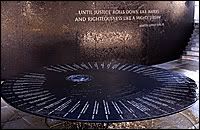
The voices of civil right’s martyrs and the humming of a distraught black woman, combined with water flowing over the names and dates of those murdered fighting for equality commences the Southern Poverty Law Center’s film, Faces in the Water. The 2005 documentary complements Alabama’s Civil Rights Memorial and is viewed at their sixty nine seat theater. This cinema is based on a true story and is written, directed and narrated by Jim Carrier.
Set in an era of violence, it depicts America’s Southern struggle through a series of black and white photos and still shots. Many scenes also use Maya Lin’s civil right’s monument as a backdrop, which adds a continuum uniting the past and present strife for an equal status quo. The film is an overview of forty men, women and children who were victimized and murdered out of sheer racism. The narrative begins with the tragedy of Emmett Louis Till, whose body was discovered in the Tallahatchie River with one eye gauged out, a 75 pound cotton gin tied around his neck and shot in the head. The fourteen year old boy’s body was found three days after he was murdered. The husband of a white woman, with the help of his brother viciously tortured and killed him for allegedly having whistled when he saw her. The child’s mother had his body returned home to Chicago, where he was given an open casket funeral. She is quoted in the film, “people had to face my son, they had to face themselves.” Despite the overwhelming evidence the murders were given a not-guilty verdict (even though they admitted their doings in court.) Jim Carrier also displays an array of pictures humanizing Emmett, allowing us to see him as a real person (pictures of him growing up.)
Although the film is dedicated to the forty martyrs, Carrier seems to tell more: the civil rights saga. One can observe that the tragic stories are told on a time line, from the beginning of the black suffrage movement to the assassination of Martin Luther King, Jr. Through vivid visualizations from the use of various shot techniques, such as shallow focus shots, he leaves us with a memory of how the struggle unfolded. His use of black and white, the dark lighting of the film helps develop a sad feeling; thus reaching the audiences’ emotions (which is again, essential to memory.) Rather then presenting another single faceted history lesson, he brings alive the multi-dimensional aspects of life in the South and the need for such movements, in a manner that the audience will not forget.
Jim Carrier working in conjunction with The Southern Poverty Law Center created a heart wrenching film. I have watched it over ten times, and still am left with an overwhelming emotional response. It reminds me of the pains and labors of the men and women who paved the path for me. The scenes of women being hosed down during peaceful marches by uniformed riot police, police dogs mauling them, the water flowing in the monument, from Montgomery to Washington D.C., church bombings, and the eyes filled with tears all for equal rights with those of different skin complexion. The sharp images Carrier uses motivate me to further educate myself and become an asset to the continuous struggle for a land of equal opportunity. The boycotts, sit-ins, and names of those murdered like Rev. George Lee, Medger Evers, Jimmie Lee Jackson and Viola Rose will be reminded to the generations who watch this film.


3 comments:
air max, sac longchamp, ray ban sunglasses, longchamp pas cher, ugg boots, ray ban sunglasses, nike free, oakley sunglasses, nike free, chanel handbags, cheap oakley sunglasses, nike outlet, louboutin, longchamp, nike roshe run, air jordan pas cher, tiffany jewelry, longchamp outlet, longchamp outlet, michael kors, prada outlet, louis vuitton outlet, louboutin outlet, louis vuitton, uggs on sale, ugg boots, louis vuitton, polo ralph lauren outlet, oakley sunglasses, louis vuitton, kate spade outlet, louboutin pas cher, polo ralph lauren outlet, tory burch outlet, tiffany and co, oakley sunglasses, ray ban sunglasses, ralph lauren pas cher, christian louboutin outlet, nike air max, nike air max, louboutin shoes, replica watches, jordan shoes, oakley sunglasses, gucci outlet, prada handbags, burberry, replica watches, louis vuitton outlet
wedding dresses, giuseppe zanotti, instyler, mont blanc, converse outlet, longchamp, babyliss, north face outlet, north face outlet, insanity workout, gucci, vans, hollister, asics running shoes, chi flat iron, ralph lauren, baseball bats, bottega veneta, timberland boots, mac cosmetics, valentino shoes, abercrombie and fitch, mcm handbags, hollister, lululemon, nike air max, hollister, celine handbags, herve leger, ghd, louboutin, soccer jerseys, p90x workout, beats by dre, vans shoes, ray ban, nike air max, nike trainers, new balance, ferragamo shoes, nike huarache, reebok shoes, lancel, nfl jerseys, nike roshe, oakley, iphone cases, jimmy choo shoes, birkin bag, soccer shoes
bottes ugg, ugg pas cher, louis vuitton, pandora jewelry, moncler, moncler, doudoune canada goose, replica watches, louis vuitton, moncler, juicy couture outlet, moncler, juicy couture outlet, ugg,uggs,uggs canada, canada goose, ugg,ugg australia,ugg italia, pandora charms, canada goose, links of london, canada goose outlet, pandora charms, canada goose uk, canada goose, marc jacobs, moncler, wedding dresses, louis vuitton, canada goose outlet, karen millen, louis vuitton, moncler outlet, sac louis vuitton pas cher, coach outlet, moncler, swarovski, ugg boots uk, toms shoes, moncler, pandora jewelry, canada goose, montre pas cher, thomas sabo, supra shoes, hollister, swarovski crystal
Post a Comment